
I came to know Kymberly Newberry while we were both students at the University of Massachusetts-Amherst. I was a master’s candidate in art history and Kym was finishing up her coursework for her PhD in African American studies. Both of us, passionate about art, museology, culture, and changing narratives, found ourselves in Dr. Walter Denny’s Museum Studies graduate seminar. Over the course of the semester we were charged with conducting a case study on a local museum of our choice. I knew there was something exceptional about Kym when she immediately disregarded Dr. Denny’s instructions to choose a local museum and commanded ownership over the Smithsonian’s National Museum of African American History and Culture in Washington DC for the semester. “Local”, after all, is a relative term. While I traveled back and forth from Amherst to Hartford to visit the Wadsworth Athenaeum, Kym caught flights to DC to speak directly with curators. In a recent conversation Kym told me that “Walter’s class actually changed my entire academic trajectory and honestly, my future. I had ALWAYS loved and studied art but somehow I got off track and ended up in International Relations and then Afro-Am… When I walked into Walter’s class, I knew that I had to let everything else that I had been sticking my nose into go, and return full tilt to my greatest love, art.”

After I graduated, Kym and I lost touch for a bit as I began my career in museums and Kym dove into her dissertation research. Earlier this year, a call came through to the Museum School from a local scholar looking to teach a class on African and African American art. After a few minutes of talking, a mutual wave of recognition hit us and we shrieked in excitement over our shared academic past and the opportunity to engender a professional partnership, as well as nourish an old friendship. Kym, Jeanne Fontaine, and I set to work to develop her upcoming series Here +54: From the Smithsonian to Soweto, Arts of the African Americas and Africa. Kym and I recently got together to talk about the series, her inspirations, and what she is reading this summer.
Paige Moreau: Can you explain the origins behind the title of your upcoming lecture series Here +54: From the Smithsonian to Soweto, Arts of the African Americas and Africa?
Kymberly Newberry: I love when people ask me this question, The title of the lecture series, Here +54: From the Smithsonian to Soweto, Arts of the African Americas and Africa, very simply is the fusing of expressive culture from “Here,” meaning artworks of African Americans, with those of artists from the African continent, of which there are 54 countries. So we’ll be talking about art from here and the 54!
PM: Why do you think it is important for people to learn about African American and African art now?
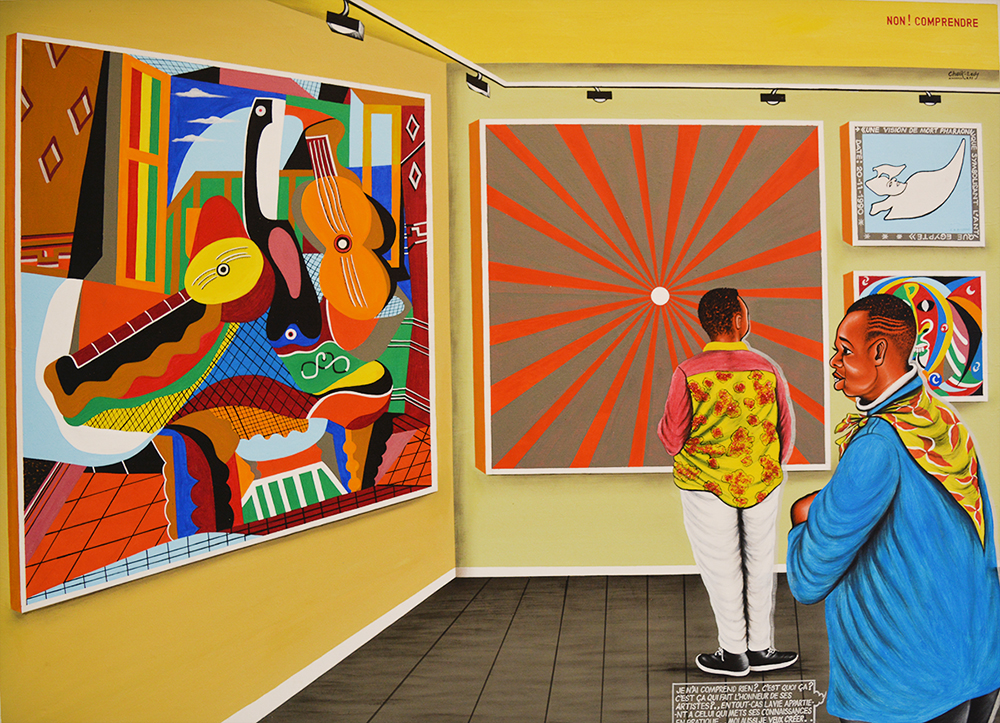
KN: Museums represent and are a reflection of the values, historical, political and social positions of the country through what they exhibit. There was a Congolese artist named Cheik Ledy, as a matter of fact, his piece, “Non Comprendre,” is the flier image for the talk I gave for my Museums a la Carte lecture last spring. His paintings, very colorfully and energetically expressed the street topics, the “goings-ons”, the incidents, and realities of his community, which were often referred to as ‘sidewalk radio.’
I think museums are in a sense supposed to be the ‘sidewalk radio,’ communicating the realities of our communities, collectively and individually, the goings-on of the world, and our cultural development.
There are loud, crashing thunderclaps in the air, and if we listen closely, we’ll hear that they are calls for museums to consider counternarratives, this is the time for a fresh coat of paint on museum’s perspectives on African American and African Diasporan visual culture!
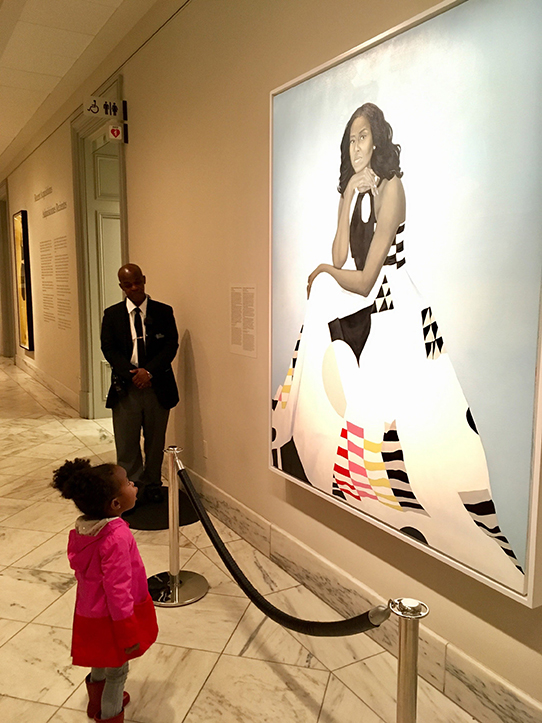
In a time when issues of representation are so pressing, a recent survey of major American museums revealed that only 1.2% of artists in collections are African American. In an photograph by Ben Hines published through the New York Times, a young girl, Parker Curry, is seen captivated by the image of Michelle Obama’s portrait (painted by Amy Sherald) in the National Portrait Gallery. This young girl seeing her own beauty smiling back at her, is a moment of staggering significance that should be revisited and referenced often when considering the significance of African American and African Diasporan representation in the museum space. I love the sentiment of the photographer Dawoud Bey, who’s nearly five decades of work is currently on view at The Whitney Museum of American Art, who said “all art carries with it an aura of magic if it is truly doing its job.”
PM: I love the concept of a ‘sidewalk radio.’ I think many institutions have traditionally considered themselves keepers of cultural heritage which makes it easy to tune out or turn down the noise of the “goings-on of the world” as you phrased it, but some museums are at least attempting to reach directly into communities and listen to their needs. By tapping into this sidewalk radio and championing artists that reflect a diversity of backgrounds and issues, museums have the power to better reflect the reality of now and remain relevant to the people they serve.
In the context of museums taking into consideration their changing roles in society, why do you think it is important for this series to be held at the Springfield Museums?
KN: I refer to my last response here, I think it has to do with museums re-contextualizing historical narratives, advancing cultural competence and most importantly, representing and reflecting their surrounding communities through inviting community co-construction. Museums are having sincere and robust conversations about who they are bringing to work in their institutions, whose work they are accessioning, who will be exhibited, where the work will be exhibited and of greater import, will it be placed in the ‘last frontier’ of the museum, the permanent collection. All of this is happening now, there is a sea change and I think it would be safe to say that the Springfield Museums, like many others, are ready to open their eyes and be more of the ‘sidewalk radio’ and be reflective of these new ways of thinking and inclusion.
PM: I completely agree, and I think that it is so important that this series will be taught by you, a local scholar. Having someone like you, who is so involved with the cultural and academic community in Western Massachusetts, bringing a microphone to these stories will only increase the impact of the series.
PM: Your series includes not only your voice but the perspectives of a number of visiting scholars. How did you come to know some of the people who will be featured in your lecture series?
KN: Two years ago, I was privileged by the W.E.B. Du Bois Department of Afro American Studies, at the University of Massachusetts Amherst, where I am currently a PhD candidate, to be named Instructor of Record, in an interdisciplinary introductory African American literature and culture course.
I am extraordinarily proud to have benefited from the trust of my department Chair and was granted full permission to develop a syllabus which allowed me to introduce a new perspective on the course. I wanted the course to guide students to a tangible understanding of the astonishing, challenging life experiences of African descended people and how creativity and the arts have been instrumental agents of triumph and change. In thinking of how to shift the energies of the course, when creating the syllabus, I consulted scholars who are experts in the fields of African and African American art and culture. When the Springfield project came about, I called on them again and asked if they would be willing to visit and they were delighted to do so!
PM: Aside from this series, what other projects are you currently working on?
KN: Every year, usually between March 17-25, the French language is celebrated during International Francophonie Week. French speakers and lovers of the French language around the globe, celebrate the French language in all its diversity. During this week, more than 1,500 events take place involving 70 countries. Around 2007, I started studying French, and fell in love. I did the thing everybody does…watch French films, listen to French music, buy tons of French language books…you know the drill…. So, when I attended celebrations during the International Francophonie Week in Los Angeles, there was hardly any representation of the 32 French speaking African countries that are bounteous with music, literature and cinema. Seeing a need for representation of African countries, in 2008 I created “Siggi Dimanche,” (which means “lift up your head on Sunday”) an annual event which celebrates the 32 French speaking African countries and the French speaking African Diaspora. By 2010, it had become one of the most highly anticipated social events of the year for the city of Los Angeles. That same year the city presented me with a Certificate of Appreciation for the contribution of “Siggi Dimanche” to the cultural fabric of the city. In 2019, we held “Siggi Dimanche,” on the campus of UMass Amherst. It was a huge success. We certainly intend to fold the event into the yearly itinerary of the university and the Pioneer Valley at large; however, last year, for obvious reasons, we were unable to move forward. I don’t know what the variants have in store for us but, I am starting to make some “just in case” plans to hold it again this year in the spring!

I’m also really excited about Chopping Okra, a new podcast I’m hosting, that will debut in the fall and is a new digital platform for The Massachusetts Review. The podcast is called Chopping Okra, because… I love okra, and my love for it starts way before it hits my plate. Chopping okra is an art, and it usually provides a much-needed moment of what I call soul quiet and contemplation. While I’m chopping, I’m thinking about my life, the world that I am creating, and how I’m showing up… or not! I’m an eternal student of the French language and love the diacritical mark called the Accent Grave ( ` ). With one quick swoop of a pen, the pronunciation and meaning of a word is changed. Chopping Okra, an hour-long program, with two segments, will feature two guests representing contrasting artistic and cultural disciplines who are inspiring, boldly ‘pronouncing’ themselves and putting their ‘accents’ on the world. See what I did there!!!
ANNNND…..I am writing my dissertation!!!
PM: And writing a dissertation is no small feat! What are your plans for the future after completing your Doctoral studies?
KN: To redefine the global perspective surrounding contemporary art of the African continent and to be a badass…whichever comes first!!!
PM: As you think about how you will redefine perspectives on contemporary African art… and becoming a badass, which I think you can already check off your list… is there a curator or scholar whose practice you look up to or model your own work on?
KN: The Nigerian curator Bisi Silva lives forever in my heart. I am greatly influenced by her work, my dissertation is greatly influenced by her work, my perspective is influenced by her work, and she will be my companion throughout my career.

PM: Where can one find you spending your spare time?
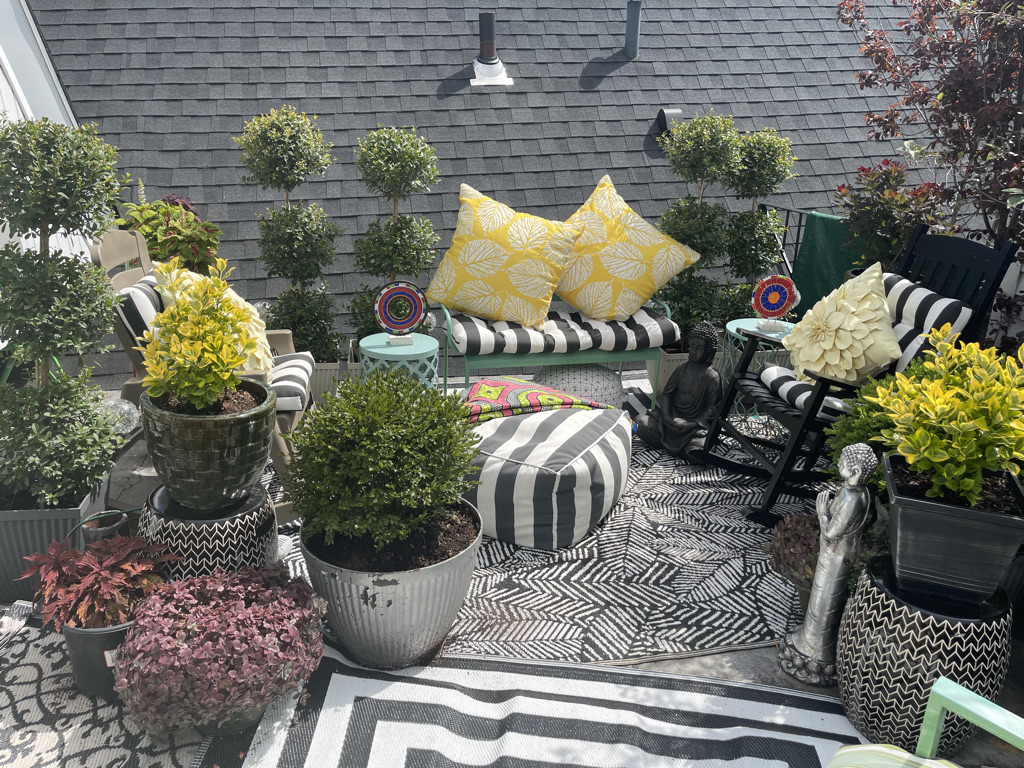
KN: In my gloriously beautiful magical garden that I create for myself every summer. I love it!! I spend as much time out there as I can, reading, blasting my music, and dancing. Sometimes I put in my AirPods and sometimes I don’t…sorry neighbors!!
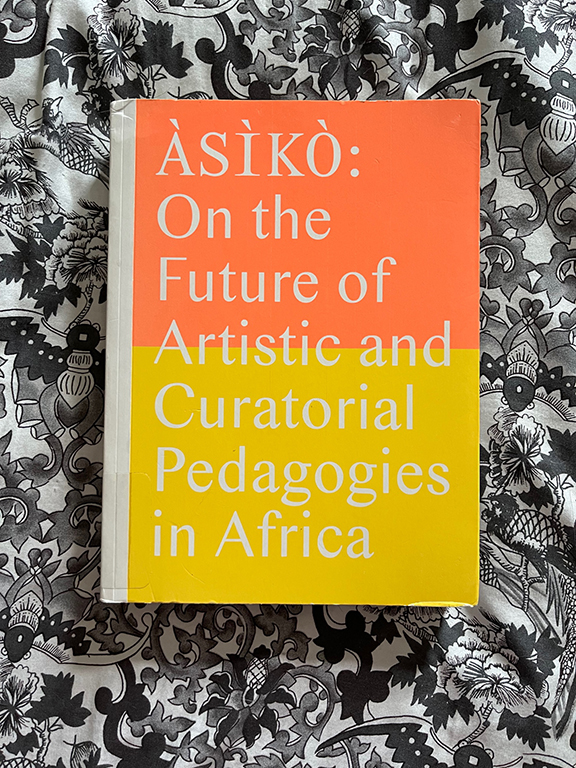
PM: What books are you reading in your garden this summer?
KN: Aside from every book under the sun about art and curating, for pleasure, after all, it is the summer and who doesn’t have a summer read, right? I’m reading The Personal Librarian, by Marie Benedict and Victoria Christopher Murray, a gorgeous historical novel based on the real-life story of the extraordinarily brilliant Belle da Costa Greene. One of the most powerful women in New York of her time, da Costa Green was the personal librarian to financier J.P. Morgan. She pursued and curated a peerless collection of manuscripts and art that became world-renowned, all the while maintaining a little secret…she was black. Though she lived a life of great privilege and moved through worlds of bedazzling wealth, passing as a white person as it is called, inflicted deep cuts, namely the fact that she could never marry…. for fear that her child would be born with dark skin and the jig would be up! An interesting note, da Costa Greene had many lovers, one of which was the art historian, Bernard Berenson, one of the most famous and influential connoisseurs of Italian Renaissance paintings and drawings.
PM: I will absolutely be adding The Personal Librarian to my reading list. And finally, while we’re thinking about consuming culture for pleasure, what has been your song of the summer?
KN: Leave The Door Open, by my man Bruno Mars. Thanks for this Paige, it’s always lovely to spend time with you. I think I’ll head out to my magical garden and blast Bruno!!!!
 Paige Moreau is the Courses and Lecture Coordinator at the Springfield Museums where she organizes the Museums a la Carte lecture series and helps to run the Museum School. Paige has a BA in Art History from the University of Connecticut and a MA in Art History from the University of Massachusetts-Amherst with a concentration in modern and contemporary art and modern architecture. Paige also works on independent curatorial projects throughout the region.
The post Interview: The Museum School Welcomes Scholar Kymberly S. Newberry appeared first on Springfield Museums.